Tuesday, December 30, 2014

currency


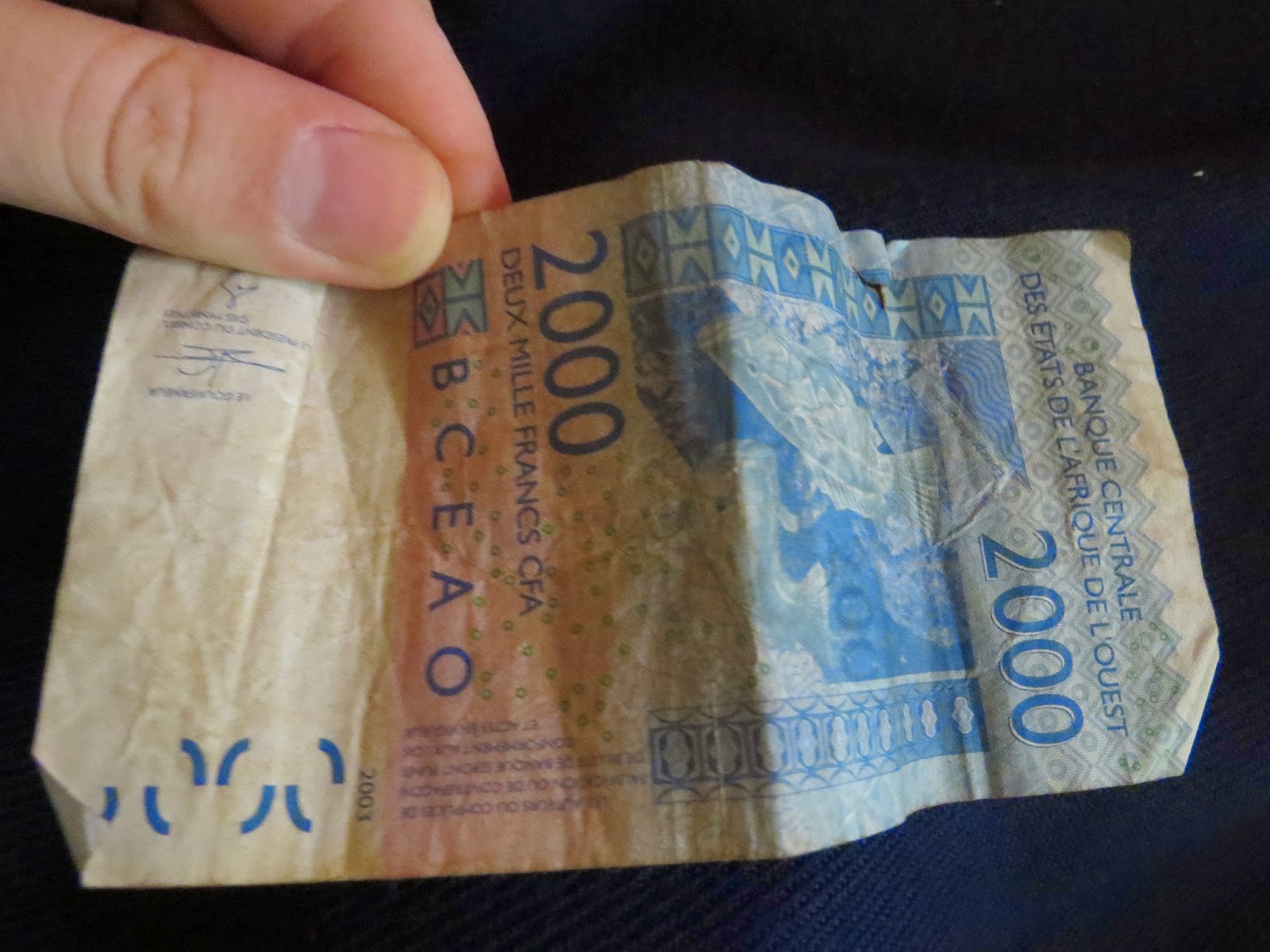
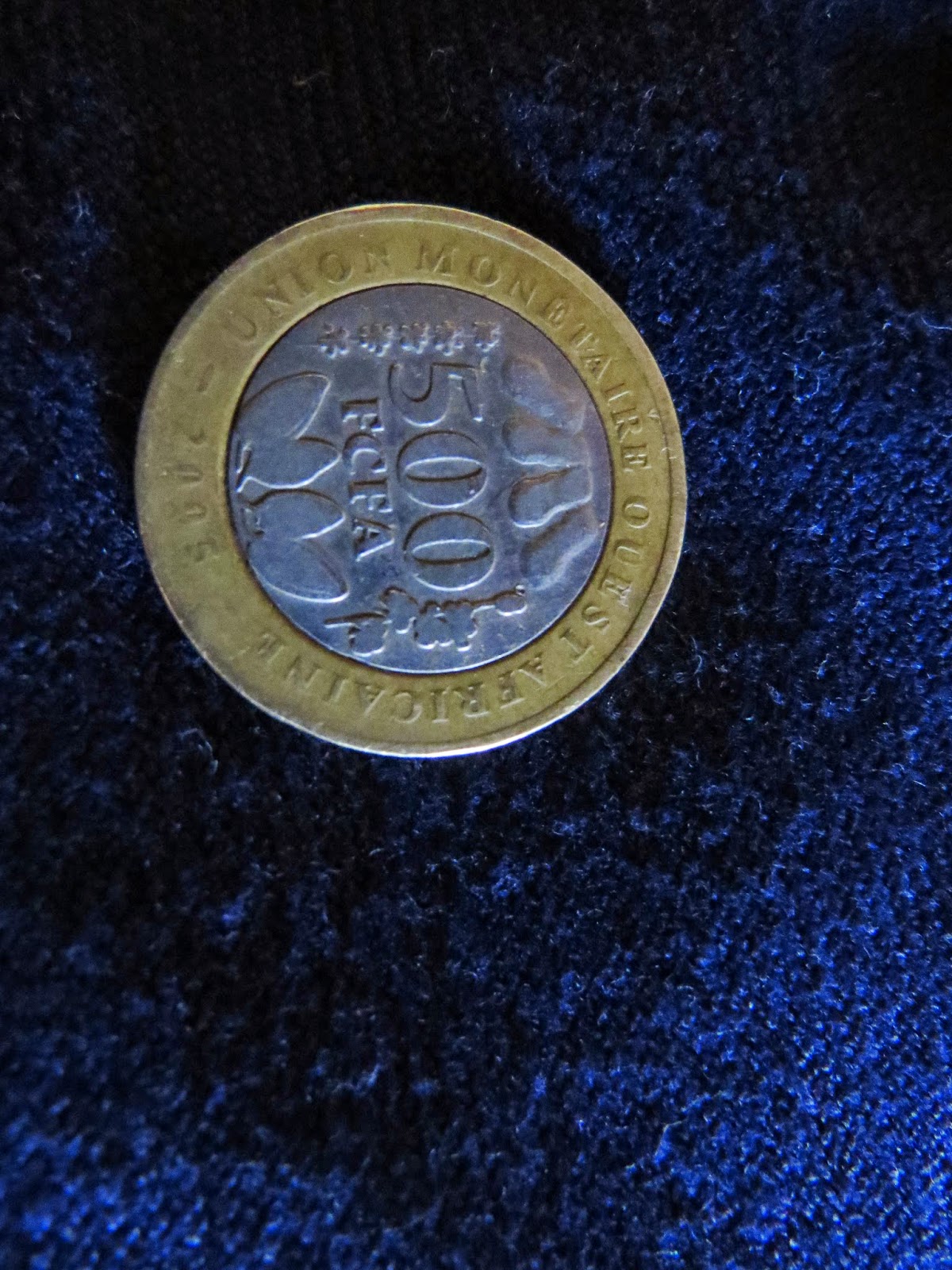
The currency in Burkina Faso is called the Franc CFA.  One U.S. dollar is exchanged for around 450 CFA.
Below you see the 1000 CFA.  This is the price of a bottle of mango juice.


 2000 CFA.  The traditional grilled chicken I've mentioned costs 2500 CFA.  

 The 200 CFA coin can purchase a bar of soap, for example.  


The 100 CFA coin can buy an egg.  With 50 Francs I can buy a small red onion at the neighbor's produce stand.  

500 Francs comes in either a coin or a small bill. 


Below is pictured the 25 CFA coin, front and back. 


Learning to use a new kind of money.  It's also the best way to learn two- and three-digit numbers in French. 

Saturday, December 6, 2014

Unfamiliar Household Objects

Photo Gallery of French Plugs and Outlets

How many people knew there was anything besides the American plug?  I was among those ignorant folks who thought normal to me was normal to everyone.  A few months before traveling, I read the blog of an American teacher who came to Burkina Faso.  She suggested bringing plug adapters.  Oh!  Good to know. 
 
Above: household outlet.  Below: plug adapters. 

Below:  An outlet strip that takes both American and French plugs.


Door Rug and Floor Mop
When I want to mop the floor - an occasion that happens about every two days - I grab the cotton rug at the front door or the bathroom door.  I was told that Burkinabe housewives often use the water left from dish washing, something I've done as well. 
Oh, I notice that I said when I WANT to mop the floor.  Maybe I should be slightly more truthful and make that WHEN THE DUST IS MUCH AND WATERMELON JUICE DRIPPED ON THE FLOOR. 
The dust is much every day now, since we've had at least a month of dry season weather.  The wind is picking up as well, and I can't imagine what the world will look like when it hasn't rained for many months. 
The mornings are cooler, a good thing for this season.  The other happy thing, of course, is that it's coming up on watermelon season!


Water
As for water, I have wondered what that will be like in the coming months.  I haven't heard of it being any more of a problem in the dry season than it was in the rainy season; still the same innocent-looking substance.

Here you see one of those large water jugs often seen in the pictures Americans see from Africa.  
They really are everyday objects around here (this was one a neighbor loaned us.)  Young boys and housewives often pass our house on the way to the fountain around the corner.  They push carts loaded with these or a large metal barrel.  Sometimes donkeys pull the cart. Or they strap them on either side of a bicycle.
They go, whenever the water runs out.  The "Komnaba" (King of Water), as they call him, sells them water at the fountain.
 Yesterday  I saw a woman biking with full jugs of water.  And the water was splashing out of her jugs, because they didn't have caps.

It is a blessing to have running water.  Same as everywhere, by every transport, you never know what is in that water.


Left:  Blessing to have electricity, too.  Light and fan switches. 


Okay, so this is acheke.  I have no idea how to describe this food.  As usual, it is a filling substance; also a nice break from rice.  The texture might be described like very large, soft couscous.  But the taste cannot be compared with any American/European food.  It is made from cassava, if that helps at all.  When I wondered, Adama said I wouldn't want to know how it is processed!  We steam it well before eating (also because it is sour when not steamed well.)
Often it is eaten with hands, first mixing it in an oil sauce of fish, onion, and tomato. 


 Left:  internet connection key. 

When we want to use the internet, we plug in this USB key, which is loaded with a SIM card.  Using this method, we must buy units of internet. 


It would be good for developing countries to have the vast internet resources more readily and inexpensively available. 

Right:  When we want to connect, this is the screen that comes up on the computer.


 Tea-Time!  

When guys (and sometimes ladies) want to spend a quiet afternoon around the charcoal burner, boiling tea, they need this equipment. 
2 little teapots - 1 for boiling the tea leaves, one for reheating with sugar.
1 large glass, for mixing with sugar (sometimes it's equal parts sugar and tea)
the tea is VERY bitter
tiny glasses, for slurping a few sips of tea.


The normal procedure is to boil the tea leaves three times, while sitting, while talking.

Happy sitting, talking tea parties to you, too!  
Love to all,
Annette

Sunday, November 30, 2014

Victory in Jesus

 "Ton nom est victoire, victoire est ton nom; si Satan ne ve pas, ca c'est ton nom!  Ton nom est victoire, victoire est ton nom; Ton nom est victoire, ca c'est ton nom."
"Your name is victory, victory is your name; even if Satan doesn't want it, that is your name!  Your name is victory, victory is your name; your name is victory, that is your name."

 Recognizing songs, singing some words here and there - and when I don't or can't, participating with feet and hands - that is a blessing. 

 I didn't stand up to testify this morning, but I sang this song.  Five women gave victorious testimonies.  More wanted come forward.  They testified that calling on the mighty name of Jesus brought victory this week - including victory over the spirit of death and the spirit of anger. 

Victory for me was a won battle against the spirit of crying.  Every day brings a challenge, sometimes great, sometimes small.  Far from home and learning things that take a good measure of strength, I feel I have a right to cry.  And every one of you bears challenges that might merit crying.  But what kind of cry is this?  Self-pity?  Stop!

 I tell you from my treacherous travel of the way: tears of pity, confusion, frustration, anger, defeat.... these do no good. 

First I fought that realization with any justification or scientific "fact" I could find. 
Get rid of my last coping strategy?  Even the thought could set my heart quivering in tears. 

Praise to my Almighty God; Jesus is victorious when I hear the Holy Spirit and cast cast out every evil spirit in Jesus' name. 

Crying out with a loud voice to Him DOES help. It is what can make my heart pulse strongly, joyfully. 

Be strong and joyful in the LORD.  Yes, in the Lord.  I can't do anything by my own strength.  I can't do anything by my own joy. 

As much as I want to bring you strength and joy by revealing to you what would revive true Christians, I am also certain that is the business of the Holy Spirit. 

Wishing you could see, I even wrote a long letter to all of you before realizing that even that is useless.  Only those whom God frees from blindness will understand what is revealed before everyone's eyes.  I don't envy the Holy Spirit's job! 

The mighty name of Jesus frees you!  By Jesus' blood you are victorious.  Be blessed.

 If you want to do something, struggle to pray for one hour - the hour that Jesus' disciples couldn't struggle through.  Pray that every chain will be broken in your life.  Take authority in Jesus' name, by the power he gave you.  Pray that Jesus fights for you. 

I know I am unable to fight for myself.    The spiritual battle is greater than most people understand. It is the grace of God to understand.  It is the grace of God to survive the battle thus far.  It is the grace of God to prosper despite the battle. 

Saturday, November 22, 2014

What's happening...

Visitors, outside the front gate.  The wall behind them surrounds the clinic to our right.


A woman sells fruit directly across from us...


Another woman sometimes comes towards nightfall with large containers full of cooked beans, rice and acheke. 


The bright sunny courtyard, the laundry...freshly washed with Saba detergent powder AND the same bar soap we use for dishes (oh yes, and to get the red dust out of white shirts = soak in bleach)

We are doing well. Better every day.  Even when a nail punctures the moto tire...
A boy brought pliers, but Aziz wasn't home.  I could actually understand what he was saying, and tell him Aziz wasn't home, but might be back in an hour.

I don't understand every word, of course, and it's difficult to form my own sentences, but I love being able to get the general idea.  Rather than always translating when we're on familiar subjects, Adama asks me first if I know what was said.

I laugh when I think about how I must sound to native French-speakers.  I suppose my sentences, translated back to English, would sound something like "You not have...."  "I am think..."  ha, ha, he, he... most people don't correct me, but Aicha (Adama's sister) is very helpful.  I am happy that she is visiting from Fada for a few days. In the picture below, she is opening "la porte" for her friend.


I watch carefully how these babies are tied on their mothers' backs.... sometimes the wrapper is just tucked in, not even tied around them.  .....eeek.  But the babies know what to do!

More Food

 Great snack food... just harvested and boiled. 


 Common vegetables for sauce... all of these went into the peanut butter sauce pictured below. 


Rice and fish sauce.  Making sauce: I have three whole fish, cut in three - head, middle section, tail.  I let them set in salty water, then bread them with corn flour and fry in heated oil.  That done and set aside, I fry onions and peppers in the leftover oil.  I add green onions, a habanero hot pepper, and soon after, tomato paste. This time, I take the bones out of the fish before adding it to the sauce.  After frying all this, I add a bit of water, potasse, salt, and maggi (spice).  Now I cover and let boil until any foam disappears from the top.  I pray.  Hey, it's tasty! 


Cutting cucumbers... I'll tell you about making salad another time.  I do know that I love eating greens after feasting on rice etc. for several days!  Lettuce, cucumber, unripe tomato, and onion... and some chicken on the side.  Yum. 

Thursday, November 13, 2014

Food

While food is very important, I've neglected to share with you what I'm tasting here in West Africa.
I have my thoughtful husband to thank for helping to ease the transition into a starchy, heavy diet.  Remembering the days of wishing for anything but the American cafeteria, the first time he came home with groceries, he found things that we had in the U.S.  He brought butter for me (instead of the usual margarine for a population without many refrigerators.)   He makes yogurt almost every day, which eases digestion and helps with constipation. 

When I was sick and couldn't stand the sight of tô, he brought fresh fruit: bananas, avocados, oranges, mango juice, and special apples (special because they are imported.)   When we were guests in Tantie's home and, sick for the second time, I loathed more than five bites of the perpetual rice, he brought delicious chicken.
Since then, chicken has been our special "eat out" meal.  That and porc-au-fou are pretty much the only prepared foods we buy.  You never know how long street food has been kept - unrefrigerated - or how they washed and made it. 
Here, the two of us can eat one entire chicken.... Huh?  They look normal with their feathers fluffed out, scratching on the dirt roads, running away from speeding motorcycles with their chicks.  They get no "chicken food" besides their bugs and food scraps.  In Bobo Dioulasso, the family saved the chaff from grinding corn to feed the chickens.  Otherwise, they're on their own. 
Now that I'm cooking, rather than relying on the graciousness of hosts and family, I'm working on perfecting the peanut butter sauce that Adama taught me to make. Peanut Butter Sauce, Sauce de Arachid, or Tiga-Diga Ng (in Djoula) was my first taste of African cooking from the chef Adama in Goshen.
We often eat fish.  Potato and plantain fries are on the menu.  Spaghetti is a break from that perpetual rice, but it takes trial and error to figure out how much water to add since it's usually cooked in the sauce.  There is no such thing as measuring ingredients.  Except for "potasse."  That is put in by the cap-full whenever cooking with tomatoes.
I'm not certain what "potasse" is, and I'm spelling phonetically since it comes in unlabeled bags.  Its purpose is to take the sourness out of sauce (I didn't know tomatoes were sour.)  Is sounds like potassium, and Adama mentioned that it might be related to sodium bicarbonate.  He said it sometimes fizzles/bubbles when adding it to sauce, as does baking soda when added to vinegar.  That makes sense if it's neutralizing acid. 
Here's a picture of potasse... the bag it comes in, some of the rock-like substance in my hand, and some mixed up in water the way we add it to sauce. 

The strangest new spice I've had goes by the name "Sumbala."  Adama cooked a sauce with fish and sumbala during our week in Bobo.  Sumbala grows in pods on a tree.  It is sold in large balls, which consist of many grains of sumbala. The balls are pounded with salt, and the ground spice is added to the sauce in great quantities.  Most distinctly, sumbala smells.  Strongly.  The bus company makes sure no passengers bring it on board, and it's important to brush teeth after eating it.  
 I was just telling my mother that some of the difficulty in learning to cook here doesn't lie in new ingredients.  Since settling into our own place, I've had the intimidating experience of providing African hospitality.  At least, it's intimidating to a novice cooking for guys who have learned to cook for themselves. 
The challenge is posed not only making a tasty sauce, but in making the right amount.  There should be enough for whoever might come.  And I must learn what can keep overnight, unrefrigerated.  And what will go bad.  My nutritionist sister was disgusted when I told her we even do this with meat! 

While learning to cook, I've learned to pray.  That is the most wonderful thing that food or country or learning has brought to me.  Now I seek it out.  Jesus is powerful and - even when the taste or the texture isn't quite right - I want everything I cook to bring peace and healing to those who eat it. Practice makes perfect and prayer makes peace.  Yum.  When will I greet a day with enough practice and enough prayer? 

Before we left Bobo, Adama's mother taught me how to make couscous with millet flour.  It is delicious mixed with yogurt to make what we call "degae."  (Spelling guessing again.)  Here's some millet couscous, ready to be steamed:


The last thing I'll show you for now is tô.  It could be considered the staple "bread" of this culture.  More explanation is given in the description of these two videos I took of Adama's mother preparing

tô.  I have yet to make this, although I hear it is simple! 


 Happy eating to all of you!  Enjoy things you know about while you've got them in your mouth and your stomach. 

Thursday, November 6, 2014

University Classroom


We stopped by the University of Ouagadougou at about 6 p.m. and slipped into the back of this first year history class.  It wasn't as crowded as some, but was very hot (despite all the fans.)  The teacher spoke with a microphone, and when a student asked a question we couldn't hear from the back of the amphitheater.  

We looked in the door of another classroom where the teacher was dictating - commas, periods, and all - an entire lesson:


Outside the buildings were masses of bicycles.  Students came late and left early as they wished.